

Numerical reasoning tests are one of the most common and often underestimated parts of the hiring process.
Whether you’re applying for a graduate role, an internship, or a professional position, there’s a good chance you’ll face one. And while the math itself isn’t usually advanced, the way it’s tested can catch many candidates off guard.
In this guide, you’ll learn what numerical reasoning tests are, why they’re challenging, and how to improve your performance.
What Are Numerical Reasoning Tests?
Numerical reasoning tests assess your ability to work with numbers in real-world scenarios.
Instead of testing abstract math, they focus on how well you can:
- Interpret data from tables, charts, and graphs
- Understand percentages, ratios, and trends
- Make accurate decisions based on numerical information
These are exactly the kinds of skills employers rely on in roles involving business, finance, operations, and data analysis.
What Do These Tests Really Measure?
At their core, numerical reasoning tests are about decision-making under pressure.
You’re typically required to:
- Extract key information from data-heavy visuals
- Perform quick calculations
- Identify patterns or changes in data
- Work efficiently within strict time limits
It’s not just about getting the right answer; it’s about getting it quickly and consistently.
Why Many Candidates Struggle
A common mistake is assuming these tests will be straightforward.
In reality, several factors make them challenging:
- Time pressure: You often have around 1 minute per question
- Information overload: Charts and tables can contain more data than you actually need
- Multi-step thinking: Many questions require more than one calculation
- Subtle traps: Small details like units or labels can change the answer completely
Even strong candidates are surprised by how different the experience feels compared to traditional math problems.
Before You Continue: Try a Real Test
Reading about numerical reasoning is helpful, but the best way to understand it is to experience it.
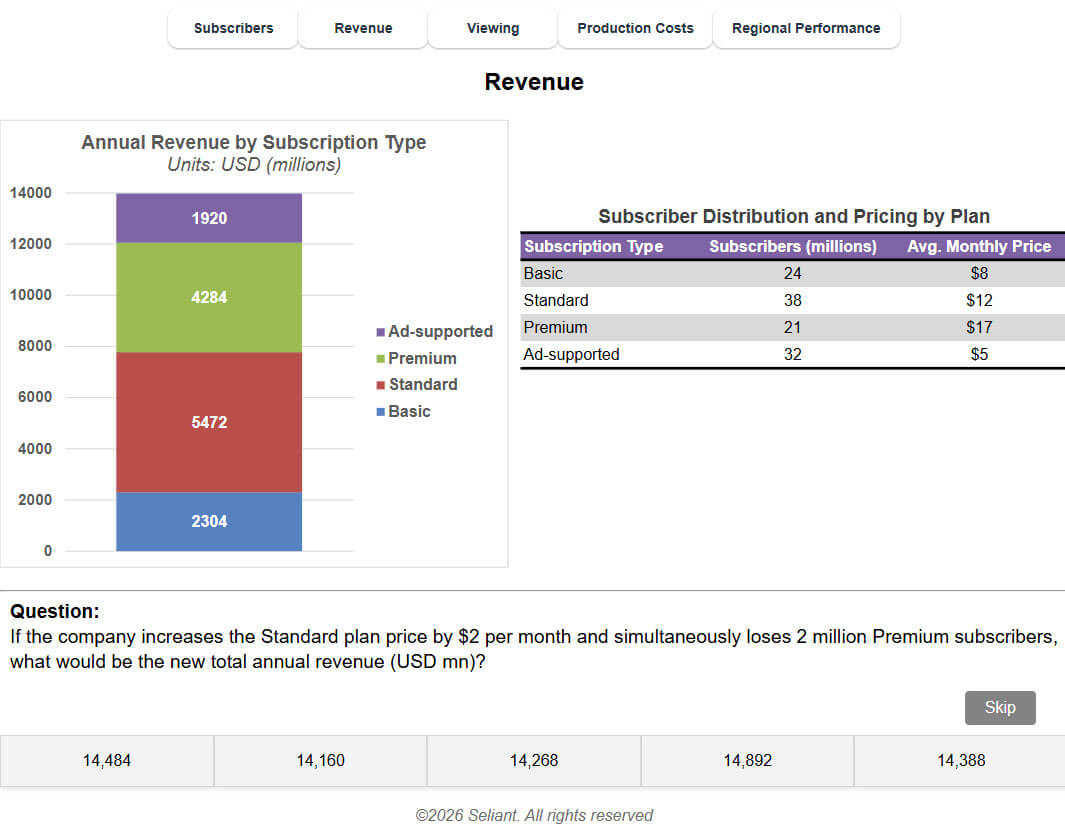
At Aptitude-test.com, we offer a free numerical reasoning test that simulates real assessment conditions:
- 18 questions
- 20-minute time limit
- Dashboard-style data similar to real employer tests
It gives you a clear picture of:
- How difficult the questions feel under time pressure
- How well you manage your time
- Which areas you need to improve
Take the free numerical reasoning test here
Key Strategies to Improve Your Score
Once you understand the format, the next step is improving your approach.
1. Focus on the Question First
Before diving into calculations, make sure you understand exactly what’s being asked.
Many mistakes come from solving the wrong problem.
2. Scan the Data Before Calculating
Don’t immediately start calculating. First identify where the relevant data is and whether all the information is actually needed.
This saves valuable time.
3. Estimate Before You Solve
A quick estimate can help you spot the correct answer faster and prevent unnecessary detailed calculations.
In many cases, precision beyond a certain point isn’t needed.
4. Use the Answer Options
Multiple-choice answers are a powerful tool.
You can often eliminate clearly wrong options or work backwards from the answers.
5. Don’t Get Stuck
If a question is taking too long, make your best guess, flag it, and move on.
Coming back later with fresh eyes is often more effective.
Time Management Tips
Time pressure is one of the biggest challenges, so having a strategy matters.
- Aim for steady progress, not perfection
- Keep an eye on the clock, but don’t panic
- Prioritize easier questions first
- Leave time at the end to review flagged questions
Remember: answering more questions correctly is better than solving a few perfectly.
Common Mistakes to Avoid
Being aware of these can instantly improve your performance:
- Misreading charts or axes
- Ignoring units such as percentages, currency, or time
- Overcomplicating simple problems
- Spending too long on one question
- Rushing and making avoidable errors
How to Prepare Effectively
1. Practice Under Real Conditions
Timed practice is essential. Untimed practice alone won’t prepare you for the real test.
2. Review Your Mistakes Carefully
This is where most progress happens.
Ask yourself:
- Did I misunderstand the question?
- Did I miss key data?
- Was it a calculation error or a strategy issue?
3. Focus on Weak Areas
Most candidates have specific weak points, such as percentages or interpreting graphs.
Targeted practice is far more effective than repeating what you already know.
4. Build Familiarity with Data Formats
The more comfortable you are with charts and tables, the faster you’ll work.
The fastest way to improve is consistent practice with realistic tests, not just theory.
Final Thoughts
Numerical reasoning tests aren’t about being naturally good at math.
They’re about:
- Understanding the format
- Applying the right strategies
- Practicing under realistic conditions
With the right preparation, most candidates see significant improvement in a short time.
Ready to See Where You Stand?
If you haven’t already, try the free simulation:
- 18 questions
- 20 minutes
- Realistic dashboard-style format
Start the free numerical reasoning test
