
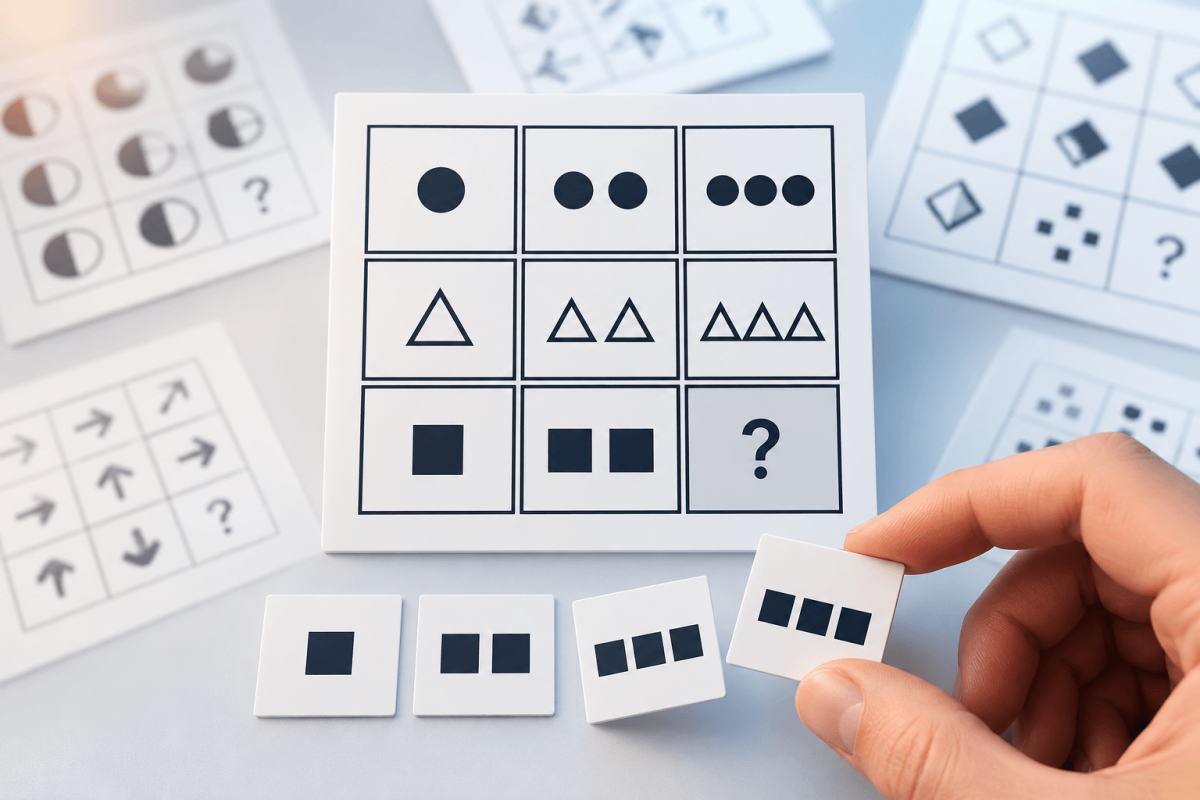
You are looking at a grid of shapes. Some are shaded, others are empty, and one box is missing. The answer is somewhere among the options below, but where do you start?
Instead of asking which answer looks right, try asking a more useful question: What changes, what stays the same, and which rule explains the pattern?
That is the approach we will use in this guide. You will learn what abstract reasoning tests assess, how to work through them systematically, and how to prepare. Five original practice examples will show you the method in action.
What Is an Abstract Reasoning Test?
An abstract reasoning test assesses your ability to identify patterns and relationships in unfamiliar information. Rather than asking you to recall facts or demonstrate specialist knowledge, it presents visual problems involving shapes, symbols, or figures. Your task is to discover the underlying rule and apply it.
A familiar format is the figure matrix: a grid containing several images and one empty space. You work out how the images relate to one another, then select the option that completes the grid. This is the format used in Aptitude-test.com’s abstract reasoning practice questions.
You may also encounter overlapping labels such as inductive reasoning and diagrammatic reasoning. Publishers do not always use these terms in exactly the same way. SHL, for example, notes that inductive reasoning tests may also be called abstract reasoning tests. Check the sample questions for your particular assessment rather than relying on its name alone.
On Aptitude-test.com, abstract reasoning is one of several non-verbal practice categories, alongside inductive reasoning, spatial ability, diagrammatic reasoning, and image analogy. The examples below focus mainly on matrices, with one related sequence question.
Why Do Employers Use These Tests?
Employers use aptitude assessments to gather additional evidence about candidates’ abilities. Abstract and inductive reasoning tasks focus on recognizing relationships and finding solutions when the information is unfamiliar. The interest is in how you reason through the problem, not whether you already know the subject matter.
Think of the shapes as a way to present an unfamiliar problem without making it depend on knowledge of a particular profession.
A test result should still be viewed as one part of the picture. Assessments provide information alongside the other evidence an employer gathers during recruitment; they do not describe everything a candidate can contribute. [1]
How to Approach an Abstract Reasoning Question
Treat each question as a small investigation. Make an observation, propose a rule, and check whether the available evidence supports it.
Start With the Features You Can Describe
Before searching for an answer, identify what is actually in the question. Use this checklist to guide your observations:
| Feature | Questions to ask |
|---|---|
| Number | How many shapes, lines, dots, or shaded areas are there? |
| Shape | Do circles, triangles, squares, or other symbols repeat or change? |
| Position | Does an object move between corners, sides, or spaces? |
| Direction | Does something rotate, reverse, or reflect? |
| Shading | Does a shape alternate between filled and unfilled? |
| Combination | Are elements added, removed, or combined? |
You do not need to spend equal time on every feature. Start with the most obvious change and investigate it.
“The shape is different” is a vague observation. “Each box contains one more circle than the previous box” is a rule you can test.
Find a Rule in a Completed Part of the Question
In a matrix, examine a complete row or column before trying to fill the gap.
Does the same relationship hold elsewhere? A rule that explains one pair of images but fails on the next pair needs to be reconsidered.
Look across both rows and columns, but do not assume that the same operation must apply in both directions. Check what the question actually supports.
Predict, Then Compare
Once you have a plausible rule, describe the missing image before examining the options in detail.
For example:
“The answer should contain three unfilled squares.”
You can now reject an option with the wrong number, shape, or shading without trying to justify it.
When you are stuck, the options can also help narrow your search. If two remaining answers differ only in shading, focus your attention there.
The final check is simple: does your answer satisfy every rule you have identified?
Five Abstract Reasoning Examples With Answers
These are original teaching examples, not questions taken from an employer’s assessment. The symbols are deliberately simplified so you can concentrate on the reasoning.
Try answering each question before reading its explanation.
Example 1: Counting Shapes
Which option completes the matrix?
| Column 1 | Column 2 | Column 3 |
|---|---|---|
| ○ | ○ ○ | ○ ○ ○ |
| △ | △ △ | △ △ △ |
| □ | □ □ | ? |
A) □ □
B) □ □ □
C) □ □ □ □
D) △ △ △
Correct answer: B — three squares.
Read the first row from left to right. There is one circle, then two circles, then three circles.
The second row follows the same counting rule, using triangles instead.
The third row must therefore contain one square, two squares, and three squares.
You can also check the columns: the first contains one shape per cell, the second contains two, and the third contains three.
Option D has the correct number of shapes but the wrong shape.
What to learn: Check both the quantity and the identity of the objects. Matching one feature is not enough.
Example 2: Following a Rotation
Which arrow completes the matrix?
| Column 1 | Column 2 | Column 3 |
|---|---|---|
| ↑ | → | ↓ |
| → | ↓ | ← |
| ↓ | ← | ? |
A) →
B) ↓
C) ↑
D) ←
Correct answer: C — an upward-pointing arrow.
Across the first row, the arrow turns 90 degrees clockwise at each step:
Up → Right → Down
The second row follows the same rule:
Right → Down → Left
Apply it to the third row:
Down → Left → Up
The missing arrow must point upward.
The columns provide another check: moving downward also turns each arrow 90 degrees clockwise.
What to learn: Be specific about the movement. “The arrow turns” is less useful than “the arrow turns 90 degrees clockwise at each step.”
Example 3: Separating Two Alternating Sequences
This example uses a sequence rather than a matrix. Each bracketed group represents one position.
What comes next?
[ ○ ] [ ▲ ] [ ○ ○ ] [ ▲ ▲ ] [ ○ ○ ○ ] [ ▲ ▲ ▲ ] [ ? ]
On a narrow screen, scroll the sequence sideways to see all seven positions.
A) ○ ○ ○ ○
B) ▲ ▲ ▲ ▲
C) ○ ○ ○
D) ○ ○ ○ ○ ○
Correct answer: A — four circles.
Instead of treating the sequence as a single changing picture, separate the odd and even positions.
Positions 1, 3, and 5 contain one circle, two circles, and three circles.
Positions 2, 4, and 6 contain one triangle, two triangles, and three triangles.
The missing item is in position 7, so it belongs to the circle sequence. It must contain four circles.
You can also describe the pattern as alternating shapes with counts of one, one, two, two, three, three, and then four.
What to learn: When adjacent images do not suggest a clear progression, check every other image. An alternating sequence may contain two simpler patterns.
Example 4: Tracking Shape and Shading Separately
In this question, outline symbols are unfilled and solid symbols are filled.
Which option completes the matrix?
| Column 1 | Column 2 | Column 3 |
|---|---|---|
| ○ | ■ | △ |
| □ | ▲ | ○ |
| △ | ● | ? |
A) ■
B) △
C) ●
D) □
Correct answer: D — an unfilled square.
There are two features to track.
First, examine the shapes. Each completed row contains one circle, one square, and one triangle. The final row already contains a triangle and a circle, so the missing shape must be a square.
Next, examine the shading. The shapes in the middle column are filled. The shapes in the first and third columns are unfilled.
The missing item is in the third column, so it must be an unfilled square.
Option A gets the shape right but the shading wrong. Option B gets the shading right but the shape wrong.
As a further check, every completed column also contains one of each shape.
What to learn: Solve separate features independently, then combine the results. Finding the correct shape does not finish the question if shading also follows a rule.
Example 5: Combining Symbols and Removing Matches
This final example requires a different kind of relationship.
Treat each cell as a collection of symbols. The order of symbols inside a cell does not matter.
Which option completes the matrix?
| Column 1 | Column 2 | Column 3 |
|---|---|---|
| ○ △ | △ □ | ○ □ |
| ○ □ ◇ | □ ◇ | ○ |
| △ □ ◇ | △ ◇ | ? |
A) △ ◇
B) □
C) △ □ ◇
D) ○ □
Correct answer: B — a square.
In each row, compare the first two cells. The third cell keeps the symbols that appear in one cell or the other, but not both.
In the first row, both cells contain a triangle, so the triangle disappears. The circle appears only in the first cell, and the square appears only in the second. The result is a circle and a square.
In the second row, the square and diamond appear in both cells. Remove those matching symbols and only the circle remains.
Apply the same rule to the third row. The triangle and diamond appear in both cells, so both disappear. The square appears only in the first cell.
The answer is therefore one square.
You can verify this using the final column: a circle and square combined with a circle leaves only the square.
What to learn: Combining two images does not necessarily mean keeping everything. Test whether shared elements remain, disappear, or are treated differently from other elements.
Can You Improve Your Abstract Reasoning Performance?
Yes, preparation can improve test performance. Research on cognitive ability testing has found average score gains with retesting. These findings do not establish a guaranteed improvement for every person or every test. [2]
The practical goal is not to memorize a collection of answers. It is to develop a method you can apply to questions you have never seen.
Build Accuracy Before Adding Pressure
Start with a small set of untimed questions. For each answer, explain the rule in a sentence.
For example:
“Each row contains all three shapes, and only the middle column is filled.”
If you cannot explain why an answer works, treat it as something to review, even when your selection happened to be correct.
Then introduce timed practice. Test publishers use practice exercises to help candidates become familiar with both the question format and the experience of working within a time limit.
Review the Cause of Each Mistake
“Wrong answer” does not tell you what to work on.
Record a more useful explanation: you missed a shading change, confused a rotation with a reflection, stopped after finding only one rule, or spent too long testing an idea that did not fit.
Use that information to choose your next practice questions.
For example, if you regularly identify shapes correctly but overlook filled and unfilled areas, make shading an explicit part of your final check.
Use Fresh Questions to Check Progress
Repeating a question can help you understand its explanation. But once you remember the answer, solving it quickly no longer shows that you can recognize the rule in an unfamiliar problem.
After reviewing a mistake, try a different question that uses a similar relationship.
Ask yourself: Can I identify the rule without remembering the picture?
Give Each Session a Purpose
One practical 25-minute session could include five minutes reviewing previous mistakes, ten minutes solving unfamiliar questions, and ten minutes analyzing your answers.
Treat that as a suggested structure, not a required training schedule.
Before starting, choose a focus: checking columns, separating alternating sequences, tracking shading, or deciding when to move on. At the end, identify one adjustment for the next session.
How to Manage Your Time
Use the instructions for your actual assessment. Publishers offer different formats, including standard multiple-choice and interactive tasks, so practice with the response style you will be using.
For a fixed-length test, dividing the available time by the number of questions gives you a useful starting budget.
For example, 18 questions in 12 minutes gives an average of 40 seconds per question.
That does not mean every question deserves exactly 40 seconds. A quick solution on one question leaves more time for another. The purpose of the average is to help you notice when one problem is consuming too much of your test.
Before relying on a “skip and return” strategy, check whether returning is allowed. Likewise, do not assume that guessing is always treated the same way. Aon’s candidate guidance, for example, describes performance tests in which incorrect answers can reduce the final score. [1]
The distinction matters. When an incorrect answer and a blank answer both receive zero, leaving a question blank offers no scoring advantage over answering it. When incorrect answers carry a penalty, the calculation changes.
Follow your test’s scoring and navigation instructions, not a universal rule found in a preparation guide.
Common Mistakes to Avoid
Stopping after finding one rule. Example 4 requires both the correct shape and the correct shading. Before selecting an answer, check whether another feature is changing independently.
Accepting a rule that works only once. An explanation that fits the first two images may fail on the rest. Test it against the other completed parts of the question.
Inventing exceptions to protect your first idea. If your proposed rule needs several special cases, set it aside and inspect a different feature. Start with the simplest relationship that consistently explains the evidence.
Measuring practice only by the number of questions completed. Review matters. Ten carefully analyzed questions can reveal weaknesses that a larger set of unexplained answers leaves unresolved.
What Is a Good Abstract Reasoning Score?
There is no single pass mark you should assume applies to every employer or assessment. SHL explicitly states that it does not set passing scores for its tests and directs candidates to the recruiting organization for that information. [3]
Do not treat a score on a short practice exercise as proof that you will pass or fail a recruitment assessment.
For your own preparation, track progress on unfamiliar questions: how accurately you identify rules, whether you can explain your answers, and how you perform within the relevant time limit.
Before Test Day
Read your invitation and complete any official examples provided. Check the device and browser requirements, arrange an uninterrupted place to work, and confirm which materials are permitted. Aon’s preparation guidance specifically recommends checking technical requirements and minimizing interruptions. [1]
If you need an accessibility adjustment, contact the recruiting organization before starting. Saville Assessment advises candidates to raise adjustment requests as early as possible so arrangements can be made in advance. [4]
Use your final practice session to review your method rather than trying to learn every conceivable pattern.
Put Your Method Into Practice
The next step is to apply the approach to unfamiliar questions.
Aptitude-test.com’s free Abstract Reasoning Test contains six questions with a six-minute time limit. Use it to practice identifying a rule, checking it against the available information, and choosing an answer within a time budget.
Start the free Abstract Reasoning Test →
For further practice, the Non-verbal Test Preparation Package includes more than 600 questions across its non-verbal categories, with explained solutions, progress charts, and test statistics.
Remember the method: observe the features, propose a rule, test it, and verify the answer. When a question looks confusing, return to those steps rather than waiting for the pattern to become obvious.
Sources and Further Reading
[1] Aon: Prepare for your online assessment
[2] Hausknecht et al.: Retesting in selection (2007)
[4] Saville Assessment: Candidate guidance
